United States 1924 half dollar KM-154

Authorization
HUGUENOT HALF DOLLAR alludes, supposedly, to the 300th anniversary of the arrival of 110 Walloons (thirty families of Lowlands Huguenots, the French name for Calvinists) aboard the ship Nieuw Nederlandt in the Hudson River region of upstate New York. Seeking to honor the 300th anniversary of the arrival of the Walloons, an organization calling itself the Huguenot-Walloon New Netherland Commission approached Congress with a plan to coin commemorative half dollars marking the event. Revenue from the sale of these coins would be used to offset the expense of public celebrations planned for 1924. Objections were raised immediately over this legislation, as the Commission's Chairman, the Reverend Dr. John Bear Stoudt, was associated with the Federal Council of Churches of Christ in America, a group which co-sponsored this coin issue. Despite the apparent violation of the doctrine of separation between church and state, Congress was persuaded to pass the Huguenot-Walloon bill on February 26, 1923. It authorized the coining of 300,000 half dollars to commemorate "the settling of New Netherland, the Middle States, in 1624, by Walloons, French and Belgian Huguenots, under the Dutch West India Company."
Huguenots and Walloons were really one and the same; Walloon was the name given to Huguenots (French Calvinists) living in southern Belgium. Periodically persecuted in Catholic France and in Holland (then partly ruled by Spain), they sought refuge outside of Europe in the New World. Toward this end, 30 families of Walloons were persuaded by the newly-formed Dutch West India Company to colonize New Netherland. This region was broadly defined as the lands between New France (Canada) and Virginia. They landed in 1624 and created the settlements of New Amsterdam (now New York City) and Fort Orange (now Albany, New York). Forty years later, these lands passed into British rule, remaining under this authority until Americans declared their independence in 1776.
The Huguenot-Walloon Tercentenary Half Dollar was to be the last coin created by George T. Morgan before his death.
Obverse

The model of the coin was created by George T. Morgan based on the ideas and drawings of Rev. Dr. Stoudt. The obverse of the coins is very interesting in that it portrays two men who had absolutely nothing to do with the landing of the Calvinist in the New World. The coin portrays the images of Admiral Gaspard de Coligny and Willem I (William the Silent), Prince of Orange. Both were said to be Huguenot martyrs, and both died decades before 1624. Admiral de Coligny was killed in the St. Bartholomew's Day massacre, in 1572. It has been said he is no more or less a martyr then those many nameless souls who died at the hand of the Romans in the early days of Christianity. Willem I became ruler of the Dutch with a vow to rid his people of Spanish rule and Spanish taxes. He joined the Calvinist Church in 1573, and was assassinated in 1584. Historians seem to agree that the assassination was to further Spanish rule in the Netherlands, and not because of religious beliefs. It seems the only real connection between these to men (other then religious beliefs) was that the daughter of Willem I, Louise, was the wife of Admiral de Coligny. The M on Coligny's shoulder refers to Mint Engraver Morgan, who made the original dies.
Reverse
The reverse displays a fanciful three-masted ship, supposed to represent the Nieuw Nederlandt bound for America, in 1624 hence the dates and inscriptions. NEW NETHERLAND refers to the settlements in upper New York state and neighboring New Jersey, 1621-1664.
Mintage
The Philadelphia Mint struck a total of 142,000 Huguenot half dollars in February and April 1924, plus 80 reserved for assay, out of the 300,000 originally authorized. by arrangement with the Huguenot-Walloon New Netherlands Commission, the Fifth National Bank of New York obtained the coins at face value, and began offering them at $1 apiece. Partly owing to pressure from the Federal Council of Churches, the churchgoing public actually bought 87,000 of the coins. The remaining 55,000 were eventually released into circulation at face value, probably unsalable owing to the protests and attacks. Survivors are apt to be VF to AU or sliders, dull and cleaned. A single matte proof is reported. No holders, cases, or accompanying literature have survived. A single uniface brass trial impression of a reverse die is known, no record of its location is available.
Specification: 0.900 fine silver, 192.9 grains (12.50 grams), Diameter: 30.61 mm (1.205 in), reeded edge. Net Weight: .36169 ounce ASW.
Catalog reference: KM 154.
- Breen, Walter H., Walter Breen's Complete Encyclopedia of U. S. and Colonial Coins, New York: Doubleday, 1987.
- Slabaugh, Arlie R., United States Commemorative Coinage, 2nd Ed.," Racine, WI: Whitman Publishing, 1975.
Link to:
- 1923-S half dollar, Monroe Doctrine Centennial
- 1924 20 dollars
- 1925 half dollar, Fort Vancouver Centennial
- 1926 half dollar, United States Sesquicentennial
- Coins and currency dated 1924
- return to United States Commemorative Coins, 1892-1954
Gallery
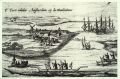
"Fort New Amsterdam of the Manhattans," 1626-28, earliest known view of New Amsterdam (New York City), at the southern tip of Manhattan Island, 1651. Joost Hartgers engraving.

Huguenot-Walloon Celebration - U. S. stamps.

