File:Hungarian currency 057.JPG


Original file (1,020 × 510 pixels, file size: 286 KB, MIME type: image/jpeg)
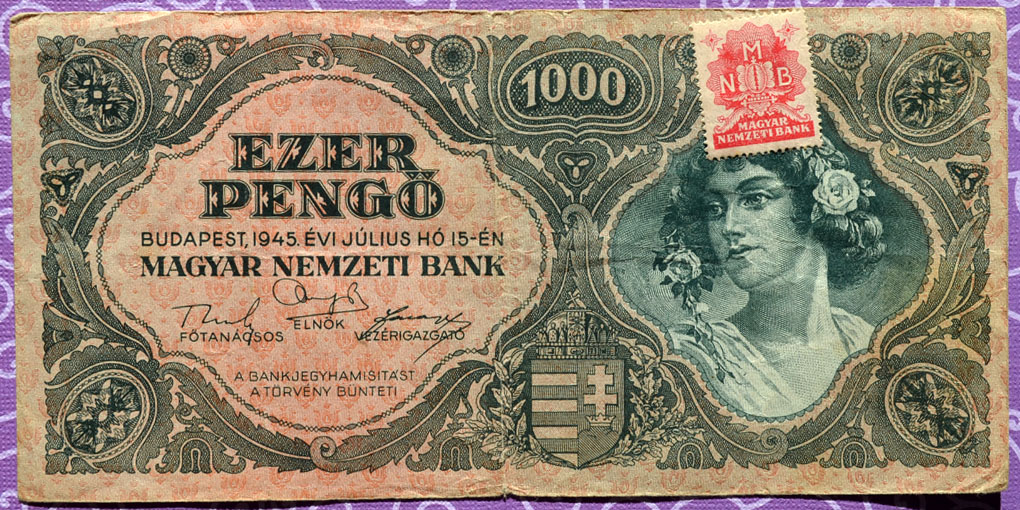
P-118, 185 × 90 mm, dated 15 July 1945, Demonetized 6 May 1946, designed and engraved by Franke Rupert and Helbing Ferenc. P-118b with stamp.
Numista comments,
"Postwar inflation series (1945–1946)
After the war the new democratic government suffered from serious lack of money, so it ordered the national bank to manufacture banknotes quickly and cheaply. There was little time to design new notes, so the plates of banknotes printed in 1926 were reused (compare the 50, 100, 1,000,000 and 100,000,000 notes with the 50, 100, 20 and 10 pengő notes from the 1926 series, respectively) as well as portraits from other notes (e.g. compare the 500 pengő note with the 500,000 korona note and the 100,000 pengő note with the 2 pengő note from 1940). Beginning with the 1000 pengő note, only denominations of integer powers of ten were used. The uncontrolled issue of banknotes aggravated inflation.
In December 1945, the government tried (and failed) to bring inflation under control by a one-off capital levy. This meant that the 1,000, 10,000 and 100,000 pengő banknotes had to be overstamped with a stamp that could be bought for 3 times the value of the banknote. Unstamped banknotes were worth a quarter of their nominal value after this campaign. Later the 100,000 pengő note was issued again in different colors – this banknote and higher denominations did not fall under the capital levy. Although there were plans to issue 10 billion (1010) pengő notes (similar in design to the 1946-version 10 Ft note), denominations higher than one billion were renamed milpengő (which stands for million pengő) and the indicated value was reduced by a factor of one million. The next denomination after the one billion pengő note became the 10,000 milpengő, which was equal to ten thousand million pengő, and had a similar design to the 10,000 pengő note. The aim was to ease everyday money handling and accounting as well as to reuse the designs of earlier banknotes with little changes.
After the one billion ("milliárd") milpengő note, a new abbreviation had to be used, since further higher denominations were necessary. This became the b.-pengő, which stands for billion pengő; where billion is on the long scale (i.e. - one million million, or 1012 pengő, rather than the short scale 109, which is "milliárd" in Hungarian). The designs were reused again with changes to the color and the addition of the "B" prefix. The highest printed denomination – the one billion ("milliárd") b.-pengő (i.e. - 1021 pengő) note – was never released into circulation, but is widely recognized as the highest-denomination government-backed note ever printed."
File history
Click on a date/time to view the file as it appeared at that time.
| Date/Time | Thumbnail | Dimensions | User | Comment | |
|---|---|---|---|---|---|
| current | 21:39, 2 March 2026 | | 1,020 × 510 (286 KB) | LatinKing2020 (talk | contribs) | Uploaded with SimpleBatchUpload |
You cannot overwrite this file.
File usage
The following page uses this file:
