File:Chile CNG 1334.jpg
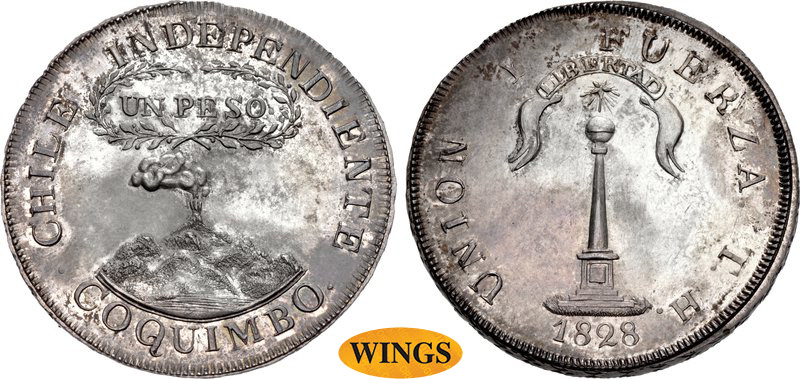
Chile_CNG_1334.jpg (800 × 379 pixels, file size: 175 KB, MIME type: image/jpeg)
This specimen was lot 1334 in Classical Numismatic Group's sale of the Lissner Collection (Chicago, August 2014), where it sold for $108,900. The catalog description[1] noted,
"CHILE, Republic. 1818-present. AR ‘Fine Type’ Peso (41 mm, 25.95 g, 12h). Coquimbo mint. Gregorio Cordovez, mintmaster. Theodor Hagen, assayer. Dated 1828 TH. KM 88. In NGC encapsulation graded MS 63. Deep mottled toning over incredibly lustrous fields. Razor sharp strike. This is the finest known Mint State example in existence, next closest graded specimen is AU 58. This cataloger had the opportunity to hold the Lissner coin and the AU coin together at a recent Chicago Coin Fair, a once in a lifetime opportunity. Ex F.C.C. Boyd Collection (Superior Stamp & Coin, 19 August 1975), lot 1787.
The ultimate jewel in the crown of the Richard Lissner Collection. This was Richard’s favorite South American coin and is the centerpiece of his South American collection. Only one other coin from Ecuador reaches the rarity and desirability of this coin. These coins were struck at a provincial mint less than fifty miles from Santiago during the early stages of the Chilean Republic.
Because of the distance between the mines at Coquimbo and the mint at Santiago, a local mint at the mines was proposed. Authorized in 1827, the new mint was supervised by Gregorio Cordovez. Under him, Theodor (or Teodoro) Hagen acted as both engraver and assayer. When the Santiago mint failed to send some of the materials necessary for the manufacture of dies, Hagen was forced to create his own for his initial trial strikes of issues from the new mint.
In late June and again in mid November 1828, two trials of the Coquimbo mint's initial output were shipped to Santiago for inspection. Included in these were examples of the 1828 peso. In both cases, mint officials rejected the coins on the basis of their lower than expected fineness and "defective" (i.e. crude) engraving and execution. These two samples constitute the so-called 'Crude Type'.
By late 1829, a screw press was installed at the Coquimbo mint and Hagen, with hubs and prepared punches now at his disposal, was able to make dies of a finer style, unlike the earlier, hand-engraved, ones used in 1828. Although the Coquimbo Mint was now equipped to strike coinage of a high standard and did begin striking trials of the new, so-called 'Fine Type' peso, the Chilean Civil War of 1829-1830 forced the Coquimbo mint to close and its bullion and trial strikes to be lost in looting. Today, no more than fourteen examples of the ‘Fine Type' peso are known, with one in the British Museum and one in the Banco de Chile collection."
File history
Click on a date/time to view the file as it appeared at that time.
| Date/Time | Thumbnail | Dimensions | User | Comment | |
|---|---|---|---|---|---|
| current | 07:52, 12 February 2021 | | 800 × 379 (175 KB) | Pastakhov (talk | contribs) | This page contains material from http://www.coinfactswiki.com/wiki/File%3AChile_CNG_1334.jpg |
You cannot overwrite this file.
File usage
The following page uses this file:
